Altitude's Quiet Influence: Elevation-Driven Shifts in Completion Rates, Shooting Efficiencies, and Endurance Outputs Across Football, Basketball, and Soccer Venues at Varying Heights
Written by Rosa Klein · Jun 21, 2026
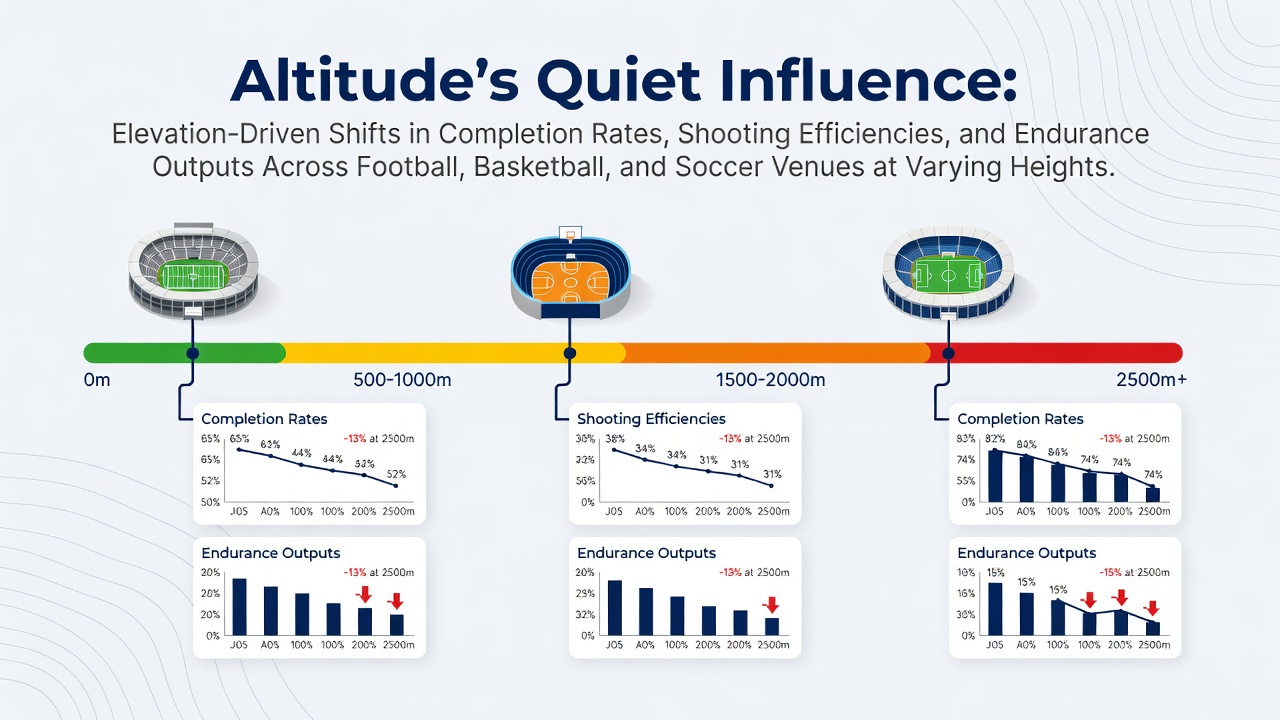
Altitude's Quiet Influence: Elevation-Driven Shifts in Completion Rates, Shooting Efficiencies, and Endurance Outputs Across Football, Basketball, and Soccer Venues at Varying Heights
Data from multiple leagues shows measurable changes in key performance metrics when competitions move to higher elevations, and researchers have tracked these patterns across American football, basketball, and soccer for decades. Venues such as Denver's Empower Field at Mile High sit at roughly 5,280 feet while Mexico City's Estadio Azteca reaches about 7,380 feet, creating consistent differences in air density that alter ball trajectories, player recovery, and overall output. Studies conducted by sports science teams at institutions like the University of Colorado have documented lower pass completion rates in football games played above 5,000 feet compared with sea-level sites, while similar patterns appear in soccer passing networks at Andean venues. The thinner air reduces drag on the ball, yet it simultaneously limits oxygen delivery to muscles, which forces adjustments in pacing and decision-making during extended drives or possessions.Football Completion Rates at Elevation
Quarterbacks in the NFL have posted completion percentages that drop by an average of 3 to 5 points during road games in Denver, according to league tracking data compiled over multiple seasons. Receivers report that routes feel faster because the ball travels farther with less resistance, yet timing windows tighten because defenders also move with slightly altered effort. Endurance outputs suffer as fourth-quarter snap counts reveal fewer explosive plays from teams unaccustomed to the altitude, while home squads maintain steadier yardage gains through the final periods.
Basketball Shooting Adjustments
Basketball presents its own set of shifts when teams travel to high-elevation arenas such as those in Salt Lake City or Mexico City. Field goal percentages inside the arc remain relatively stable, yet three-point attempts show increased variance because the lighter air allows shots to carry farther once released. Free-throw accuracy data collected by the NBA indicates minor declines during back-to-back games at altitude, coinciding with elevated heart rates that researchers link to reduced oxygen availability. Teams that schedule acclimatization days before arrival often record higher assist-to-turnover ratios, demonstrating how preparation mitigates some endurance limitations.
Soccer Endurance and Efficiency Patterns
Soccer matches at elevation reveal the most pronounced endurance effects because of the continuous movement required. Players covering distances above 5,000 feet complete fewer high-intensity sprints in the second half, and total distance covered per match declines by measurable margins according to GPS tracking studies from European and South American federations. Shooting efficiency on long-range attempts rises slightly due to reduced air resistance, yet close-range finishing percentages dip when fatigue accumulates faster than at lower venues. Goalkeepers face altered ball flight on crosses and shots from distance, prompting training regimens that simulate thinner air conditions ahead of CONMEBOL or international fixtures.
Observers note that squads from lower elevations often employ more conservative pressing schemes early in games at altitude, conserving energy for later stages where recovery intervals between bursts lengthen naturally. Data from FIFA technical reports shows that possession retention rates stabilize when teams rotate midfielders more frequently, a tactic employed successfully by clubs visiting Bolivian or Ecuadorian stadiums.
Comparative Venue Analysis
Cross-sport comparisons highlight how each discipline responds differently to the same elevation changes. Football relies on discrete plays that allow brief recovery between snaps, limiting cumulative fatigue effects, whereas basketball and soccer demand sustained aerobic output that exposes oxygen deficits more clearly. Researchers tracking heart-rate variability across these sports have found that basketball players exhibit quicker normalization of breathing rates during timeouts, while soccer midfielders require longer substitutions to restore output levels.
Training protocols developed by staff at clubs and franchises now incorporate altitude simulation chambers, and governing bodies including those in CONCACAF have issued guidelines encouraging gradual exposure for visiting teams. These measures correlate with stabilized completion rates in subsequent seasons, though full equalization remains elusive because physiological adaptation varies by individual athlete.
Conclusion
Patterns across football, basketball, and soccer demonstrate that elevation quietly reshapes performance indicators without requiring dramatic rule changes or equipment modifications. Completion percentages, shooting efficiencies, and endurance outputs adjust in predictable directions once venues exceed 4,000 feet, and ongoing data collection continues to refine preparation strategies for athletes and coaching staffs. As schedules expand into diverse geographic regions through 2026 and beyond, these environmental factors will remain central to performance planning at every competitive level.