Seasonal Fixture Congestion Impacts on Recovery Metrics for Premier League Midfielders and NBA Rotation Players
Written by Finley Butler · Jul 1, 2026
Seasonal Fixture Congestion Impacts on Recovery Metrics for Premier League Midfielders and NBA Rotation Players
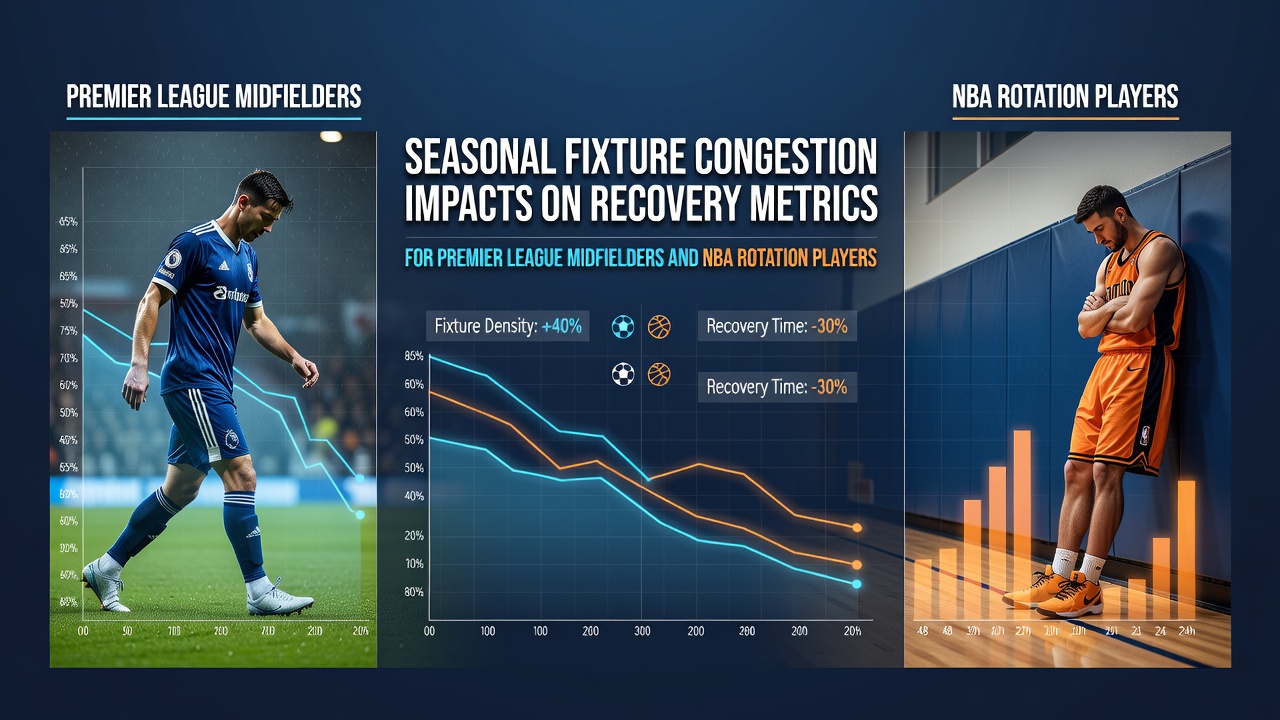
Fixture congestion shapes recovery patterns across elite soccer and basketball schedules, and data from recent seasons shows how dense calendars affect Premier League midfielders alongside NBA rotation players who log heavy minutes. Researchers track variables such as sleep duration, heart rate variability, and muscle soreness to quantify these effects, while training staffs adjust workloads based on accumulated fatigue signals rather than calendar dates alone.
Defining Seasonal Fixture Congestion
Seasonal fixture congestion arises when teams play multiple matches within short windows, often with limited rest days between contests, and this pattern appears regularly in both the Premier League winter period and the NBA regular season stretch from January through March. Studies indicate that players face three or more games in seven to ten days during peak stretches, which compresses the time available for physiological restoration and increases reliance on monitoring tools to prevent performance drops.
League schedules contribute directly to these clusters, since television rights, international breaks, and travel demands create unavoidable overlaps, whereas medical teams respond by rotating personnel and modifying training intensity to maintain output levels across the roster.
Recovery Metrics in Focus
Recovery metrics include objective measures such as countermovement jump height, creatine kinase levels, and subjective wellness questionnaires that capture fatigue, soreness, and mood states, and analysts compile these readings daily to identify when players fall below established baselines. Premier League clubs and NBA franchises both deploy wearable devices that record overnight heart rate variability alongside GPS-derived workload totals, allowing staff to correlate fixture density with subsequent drops in these indicators.
Evidence from performance databases reveals that midfielders covering high distances in consecutive matches show prolonged elevations in muscle damage markers, while NBA rotation players who average over 30 minutes per game during back-to-back sets exhibit reduced sleep efficiency in the following nights.
Premier League Midfielder Patterns
Premier League midfielders often encounter the most congested periods between December and February, when cup competitions add fixtures to an already packed league calendar, and positional demands require sustained high-intensity running that taxes both aerobic and neuromuscular systems. Data collected across multiple campaigns shows that players logging fewer than four full rest days between matches record average increases of 15 to 20 percent in perceived soreness scores compared with those who receive extended recovery windows.
Teams that integrate position-specific recovery protocols, such as targeted mobility sessions and nutrition timing aligned with kickoff times, manage to stabilize heart rate variability readings more effectively than squads relying solely on passive rest, and these adjustments appear most beneficial for central midfielders who accumulate the highest total distances per match.
NBA Rotation Player Responses
NBA rotation players navigate a schedule that includes frequent back-to-backs and occasional three-games-in-four-nights sequences, particularly during the middle third of the season, and research indicates that guards and wings who play 28 or more minutes in such clusters display measurable declines in next-day jump performance and increased reports of lower-body fatigue. League-wide tracking systems document how travel across time zones compounds these effects, since circadian disruptions extend the time required for full neuromuscular recovery beyond the standard 48-hour window.
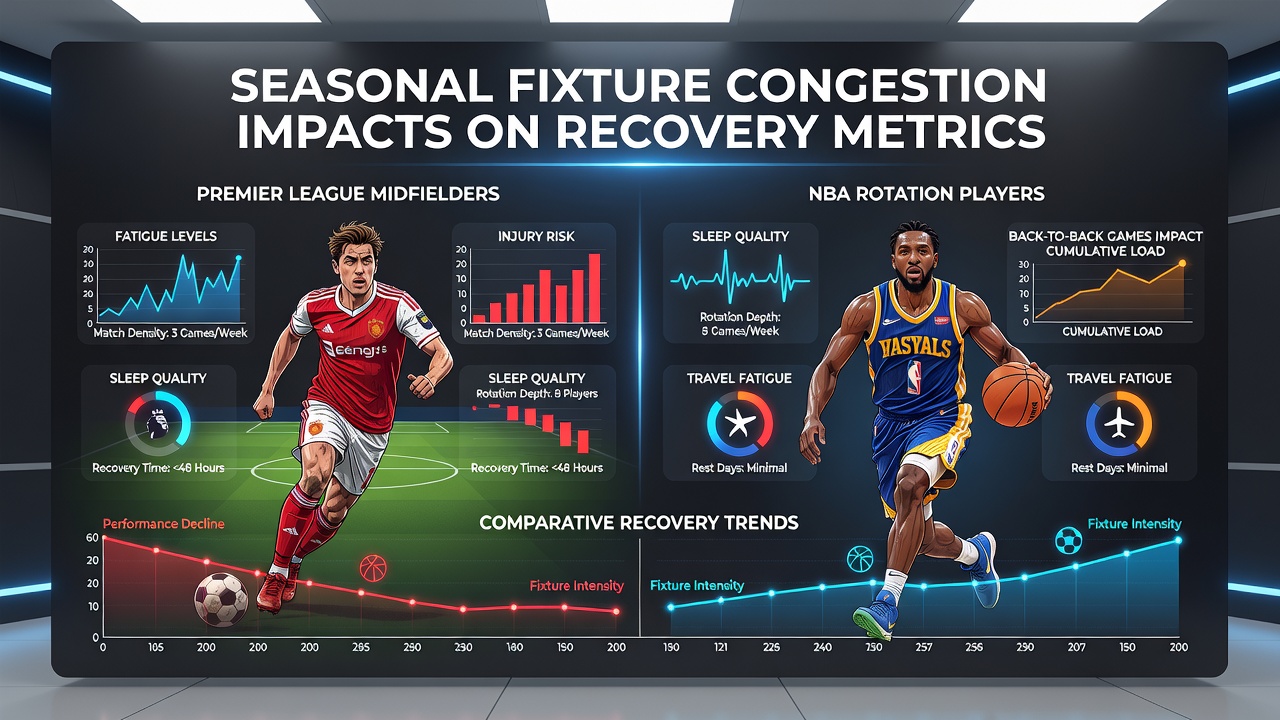
Franchises that employ load-management strategies, including minute restrictions and strategic rest for high-usage rotation members, maintain more consistent recovery profiles throughout the season, whereas teams without such systems observe greater variability in wellness scores during dense stretches. Figures from the 2025-2026 campaign, which extended into July 2026 due to playoff scheduling adjustments, further highlighted how extended postseason runs amplify the cumulative impact on players who already navigated heavy regular-season loads.
Comparative Observations Across Leagues
Direct comparisons between the two sports reveal shared vulnerabilities in central positions that demand constant decision-making and positional coverage, yet differences emerge in recovery timelines because soccer matches last 90 minutes with continuous movement while basketball contests feature frequent stoppages that allow brief intra-game recovery. Longitudinal datasets compiled by sports science groups show that Premier League midfielders require approximately 72 hours to return creatine kinase levels to baseline after congested periods, whereas NBA players often stabilize within 48 to 60 hours when travel remains domestic.
Both populations benefit from individualized monitoring rather than uniform rest protocols, since genetic factors and prior injury histories influence how quickly each athlete rebounds from repeated high-effort exposures. Organizations that integrate multi-sport recovery research adapt practices from one league to inform the other, creating cross-pollination of techniques that address similar physiological stresses despite differing game structures.
Monitoring Tools and Schedule Adjustments
Modern monitoring relies on integrated platforms that combine GPS, heart-rate, and subjective input to generate daily readiness scores, and coaching staffs use these outputs to decide rotation patterns before congestion peaks rather than reacting after performance declines appear. In July 2026, several Premier League and NBA medical teams participated in joint workshops focused on standardizing recovery thresholds across sports, drawing on datasets that span multiple seasons to refine predictive models for fixture-dense periods.
Adjustments such as reduced training volume on match-plus-one days and increased emphasis on sleep hygiene protocols have produced measurable stabilization in recovery metrics, particularly when implemented consistently across entire rosters instead of isolated star players. These approaches rely on objective thresholds rather than assumptions about individual resilience, allowing teams to distribute minutes more evenly during critical schedule windows.
Conclusion
Seasonal fixture congestion continues to influence recovery trajectories for Premier League midfielders and NBA rotation players through measurable changes in physiological and perceptual markers, and ongoing data collection supports the development of tailored interventions that account for sport-specific demands and individual responses. Continued refinement of monitoring systems and schedule-aware planning offers pathways to maintain performance stability even when calendars remain tightly packed.